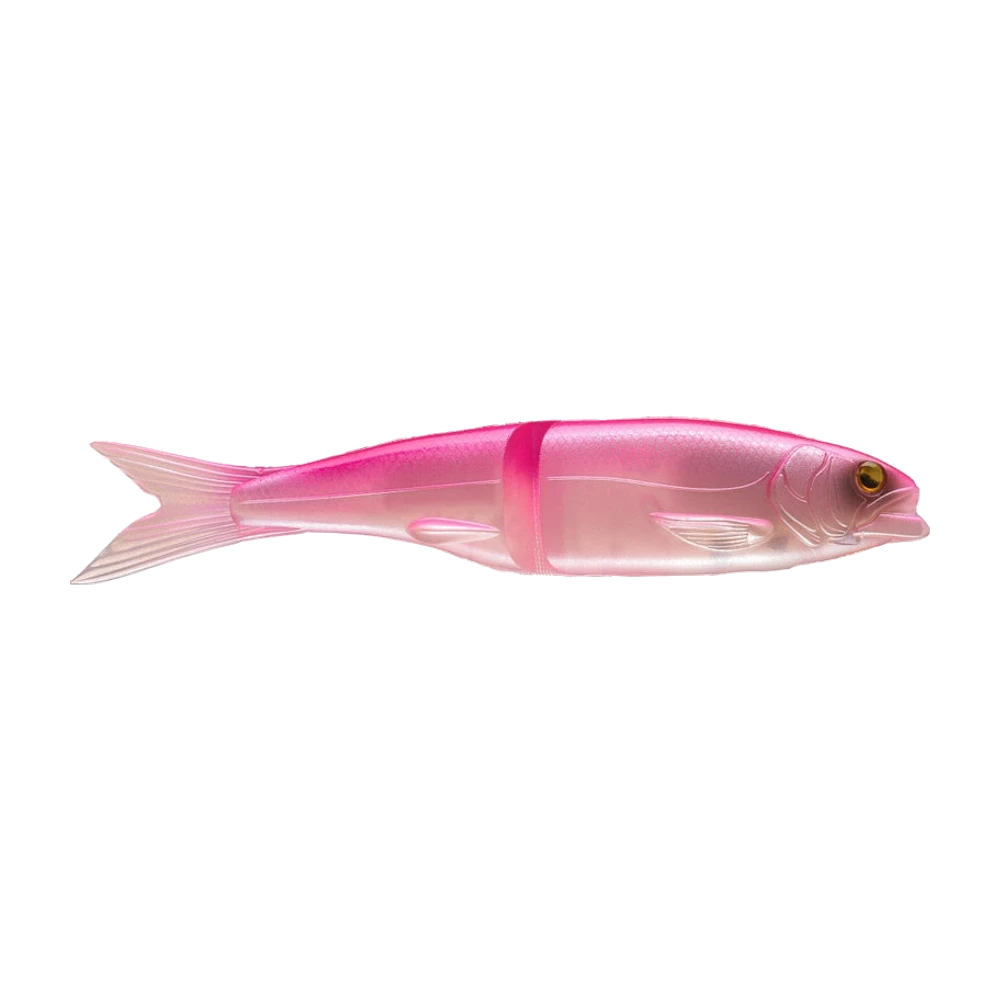
Raid Japan Osakana Slide 170: the jointed swimbait that slides flat
Not sure this lure fits YOUR spot today? CarnaFish tells you in 10 seconds, from a photo.
There comes a moment on a big spot when you stop hunting for bites and start hunting for one fish. You know it is there, you saw it follow once, and nothing you have thrown for an hour has made up its mind. That is the window for large jointed swimbaits: a lure that takes up enough room in the water for a holding fish to decide the trip is worth it. The Osakana Slide 170 belongs to that family, with a clear bias — lateral glide rather than tail kick.
What the spec line says, and what it hides
Raid Japan publishes a single spec line for this bait, and it comes down to three values: 6.7 in, 1.6 oz, class Floating. That is roughly 17 cm and 45 g, with a body listed as floating. No size variants: one format only.
That line is worth stopping on, because it seems to contradict the rest of the description. Raid Japan talks about a buoyant body that lets the bait free fall in a completely horizontal position. Floating and sinking at once? The two statements are compatible, as long as you read them in the right order: it is the bare plastic that floats, and it is the hardware that takes it down. The supplied assist hook, its swivel, and the nail sinker you can slide into the belly pocket all load a body that would otherwise rise. What the brand is claiming is not a density, it is a falling attitude: flanks level, rather than nose down.
The practical consequence matters, and few people state it plainly: on this bait, you decide the final density. Rigged bare with the assist alone, it works very high and refuses to go down. With a modest nail sinker in the belly, it becomes a subsurface bait that glides between two water layers. With a heavier one, you move into breakline fishing. Raid Japan presents the belly pocket in exactly those terms: a way to set your range according to the mood of the fish. The maker publishes no weight-to-depth chart, though, and it would be wrong to invent one: you build it yourself, counting the seconds of descent over a bottom whose depth you already know.
A lower jaw that works like a lip
This is the most interesting technical detail on the bait, and it is easy to miss in the photo. The lower jaw extends forward into a small flat shelf — Raid Japan calls it a semi-lip shape. It is not there to dig the lure down the way a crankbait lip would: it is there to grab water and kill lift.
The problem with every swimbait of this size is that past a certain retrieve speed, water slips under the body and lifts it. The bait climbs, eventually blows out on the surface, and you lose the action at the precise moment you were speeding up to trigger a reaction. That shelf under the chin pins the nose down and pushes that threshold back. It is what lets the maker claim a usable speed range running from dead slow all the way to a genuinely fast retrieve without the lure jumping out.
There is a second benefit, less advertised but real on this geometry: a nose that grabs water breaks sideways more sharply on a hard twitch. That is the mechanism behind the lateral glide, and it is exactly what the lure is named after.
Working it: hunt the glide, not the roll
A classic jointed swimbait works on a steady retrieve, through the undulation of the rear section. This one can do that, but that is not where it is most interesting. The description stresses a reaction effect obtained through a quick sliding action and abrupt movement — in other words, a bait you break with the rod.
The rhythm that suits this profile best comes in three beats. A slow straight retrieve over a few metres to get the body swimming and settle the bait in its layer. Two or three short, sharp twitches, rod tip low, a few centimetres off the water, sending the bait off to the side. A clear pause, during which the body levels out and sinks slowly. That is where the bite usually comes, and it is the whole point of the horizontal fall Raid Japan claims: a bait that falls flat stays visible from a distance and never looks like an inert object.
The mistake that ruins this bait
Fishing it with the rod held high. On a large gliding swimbait, a rod pointed at the sky turns every twitch into an upward pull: the bait climbs instead of sliding, and the half-lip under the chin no longer does anything. Keep the tip low, almost on the surface, and make the twitches short and horizontal. The other mistake, a simpler one, is oversizing the nail sinker to get down fast: you kill the glide, the bait noses over, and you end up with a 45 g swimbait fishing like an oversized jig head.
One field tip for the fall: never keep the line tight during the pause. If you hold the line, the bait pivots and swings back towards you instead of settling flat, and you lose exactly what you paid for. Leave a small loop of slack, watch the line rather than the rod, and set the hook as soon as it moves sideways.
The line-thru system, and why it changes the wear
What really separates this bait from a swimbait built on a rigid harness is its line-thru system: the line runs through the body and is tied to an assist hook fitted with its own swivel. On the hookset, the soft body slides up the line and frees the hook.
Two effects, both stated by the maker. First, the body no longer absorbs the violence of the hookset: at this price point that is no detail, since a conventional swimbait is finished after a few good fish once the harness starts tearing the plastic. Second, the fish loses its leverage: it can no longer use the mass of the bait to throw the hook during the fight, because that mass has travelled up the line, well away from its jaws.
It is the same principle as on a Savage Gear Line Thru Seeker, with a different philosophy: the Seeker is a straight-retrieve bait, the Osakana Slide is a twitching bait. If you want a non-jointed soft equivalent, the Megabass Magdraft covers the straight-retrieve search role. And on a spot where you want the volume of a jointed bait with less glide and more kick, the Rapala Peto is the other answer.
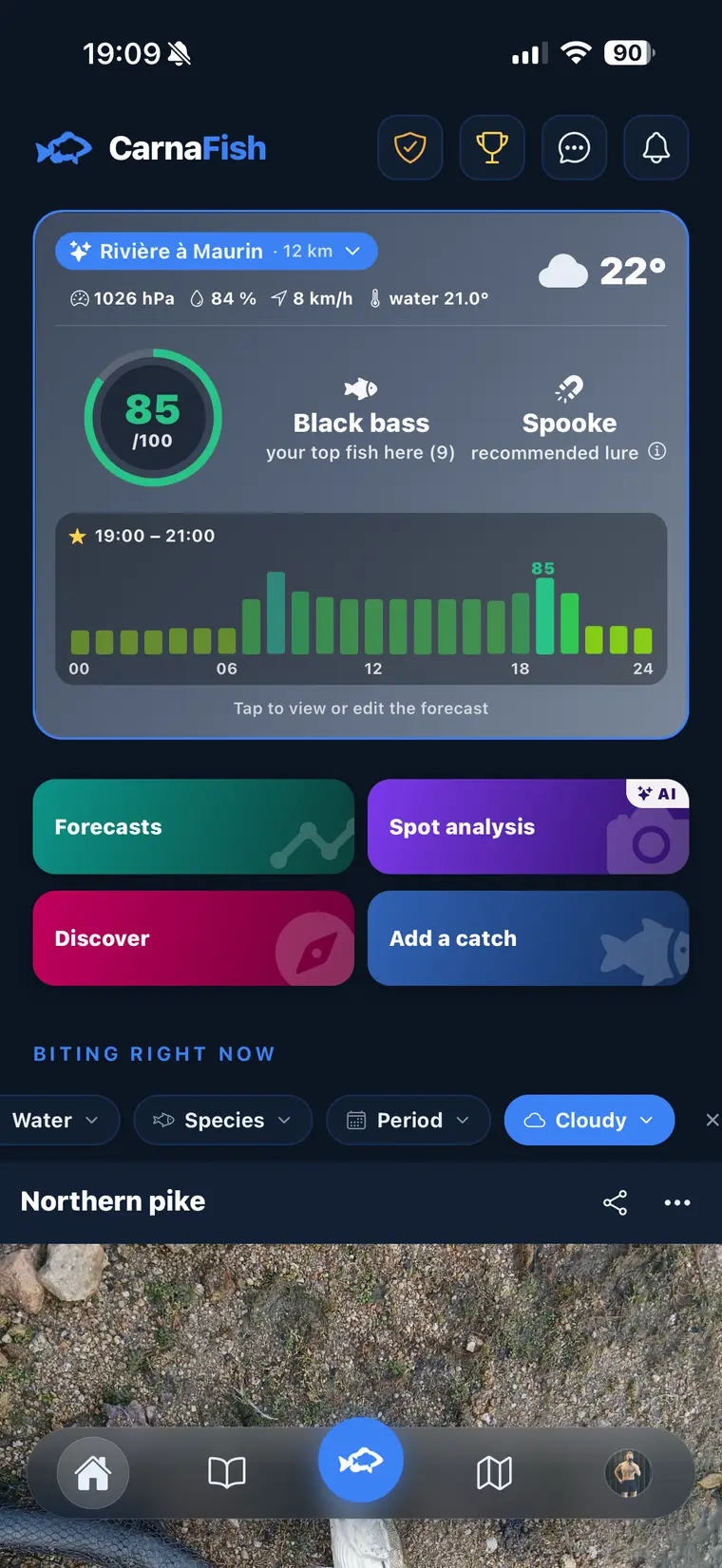
Not sure what to tie on?
Photograph your spot: CarnaFish reads the scene, cross-checks the conditions and gives you the zone, the lure and the retrieve. Free on iOS and Android.
Colours by water clarity
Raid Japan advertises two colour families, bright or natural, to cover every level of water clarity, without publishing a detailed chart. In practice, three choices are enough.
- Clear water and strong light: a translucent silver or gold natural, which lets light through and gives nothing away at close range, where a fish has all the time it needs to study a 17 cm bait.
- Overcast skies or lightly stained water: the translucent pearl pink from the photo, an in-between tone that keeps some translucency while staying easy to pick out from a distance.
- Stained water, high water, late in the day: a solid bright tone or a very dark back. On a bait this big, the silhouette matters more than the exact shade.
In Europe: bass, and pike with conditions
Raid Japan designs for bass, and that is where this bait belongs: adult fish, deep clean spots, late summer and autumn. Across most of Europe a 17 cm swimbait is also an obvious pike size, and there is no reason to avoid that use — with one serious caveat: a soft body with a line running through it does not last long against pike teeth, and the line-thru system includes no protection whatsoever. If you fish it on a pike spot, a wire or titanium leader is mandatory, and accept that the plastic will wear fast.
Picking the right water layer before tying on a bait this size is half the job: CarnaFish reads a photo of the spot and suggests the zone and depth to attack first. And to place this format among the other families of big predator lures, our guide to choosing a pike lure covers the basics.
Key points
- One format only: 17 cm, around 45 g, class Floating. The bare plastic floats; the hardware and the nail sinker take it down.
- The belly pocket lets you set your own water layer; no weight-to-depth chart is published, so you build it by counting the descent.
- The half-lip formed by the lower jaw kills lift and allows a fast retrieve without the bait blowing out.
- Line-thru rigging with an assist hook: the body slides up the line on the hookset, so it wears less and the fish loses its leverage.
FAQ
Does the Osakana Slide 170 really float?
Raid Japan's table lists it as Floating, so yes, for the bare body. Once the assist hook, the swivel and a possible nail sinker are in place the whole thing goes down — and the maker claims a flat fall rather than a nose dive.
What nail sinker should go in the belly pocket?
The maker publishes no match between sinker weight and depth, so there is no honest number to give. Start with no weight at all, watch the rate of descent, and add the minimum that gets you into the layer you want.
Do you need a dedicated rod to cast 45 g?
Yes. A swimbait-rated casting setup able to handle 30 to 60 g of lure, with braid of at least 30 lb class. A rod that is too soft will neither cast that volume nor transmit the sharp twitches that produce the glide.
What does the line-thru system actually change?
On the hookset the soft body runs up the line and clears the hook. The bait therefore takes less strain and lasts longer, and the fish can no longer lean on the mass of the lure to throw the hook during the fight.
Will this swimbait catch pike?
The size clearly suits it, but plastic with a line running through it suffers badly from teeth. A wire or titanium leader is essential, and expect a far shorter life for the body than on bass.
How do you work it when the fish are inactive?
Slow everything down and stretch the pauses. A very slow retrieve, two short twitches, then five to ten seconds of stillness while the bait settles back down flat. It is the falling phase, not the retrieve, that triggers most bites on this kind of lure.
The full bass lure guideSeason-by-season strategy: which family of lure, when, and why.Go from theory to fish
CarnaFish reads your spot from a photo and gives you the game plan: zone, lure, retrieve. Free on iOS and Android.