Rapala Claptail: the topwater that makes two sounds at once
Not sure this lure fits YOUR spot today? CarnaFish tells you in 10 seconds, from a photo.
There are summer mornings when the surface is so flat that a popper or a walking bait goes unnoticed: the fish is sitting under the weed, a long way off, and it needs a reason to leave its post. Sound is sometimes enough, provided it is odd enough not to blend in with everything else. That is the whole bet behind the Claptail — not a bigger wake, but a noise that does not come from a single place.
Two pieces of metal meeting each other
The mechanical principle of the Claptail is unusual and worth understanding before you work it. At the back of the body, Rapala has fitted a metal prop and, just below it, a trailing blade. On the retrieve, the two parts spin or vibrate in the same volume of water and end up striking each other. Rapala claims a two-tone sound from that collision rather than from the churn of the prop alone.
That is where this bait parts company with classic prop baits. An ordinary prop bait makes a continuous, even noise: a rustle of water. Here, on top of that rustle, there is an intermittent metallic clack, because two rigid parts touch. The acoustic signature is therefore broken up and irregular, and that is precisely the kind of signal that carries across a flat surface.
The body itself is plastic, weighted according to Rapala to lengthen casts and keep the retrieve consistent. That matters on this type of bait: a poorly balanced prop bait tumbles on the cast, fouls the line, and forces you to slow down just to keep it running straight.
Three sizes, and how to read the spec table
Rapala lists three versions, all classed Topwater. The table gives lengths in inches and weights in ounces:
| Model | Published length | Published weight | Metric equivalent |
|---|---|---|---|
| Claptail 75 | 3 in | 3/8 oz | about 7.5 cm and 10.5 g |
| Claptail 90 | 3-1/2 in | 9/16 oz | about 9 cm and 16 g |
| Claptail 110 | 4-3/8 in | 7/8 oz | about 11 cm and 25 g |
One remark matters when reading that table: the imperial figures are themselves conversions. The names 75, 90 and 110 are millimetres, and the published inches simply translate them back — 4-3/8 in works out at 111 mm, not a measurement taken in inches. Same logic on the weights: a fraction like 9/16 oz does not exist in any sinker catalogue, it is the rounding of a metric value near 16 g. In other words, treat these equivalents as orders of magnitude, not as gram-accurate measurements. For picking a rod, that is more than enough.
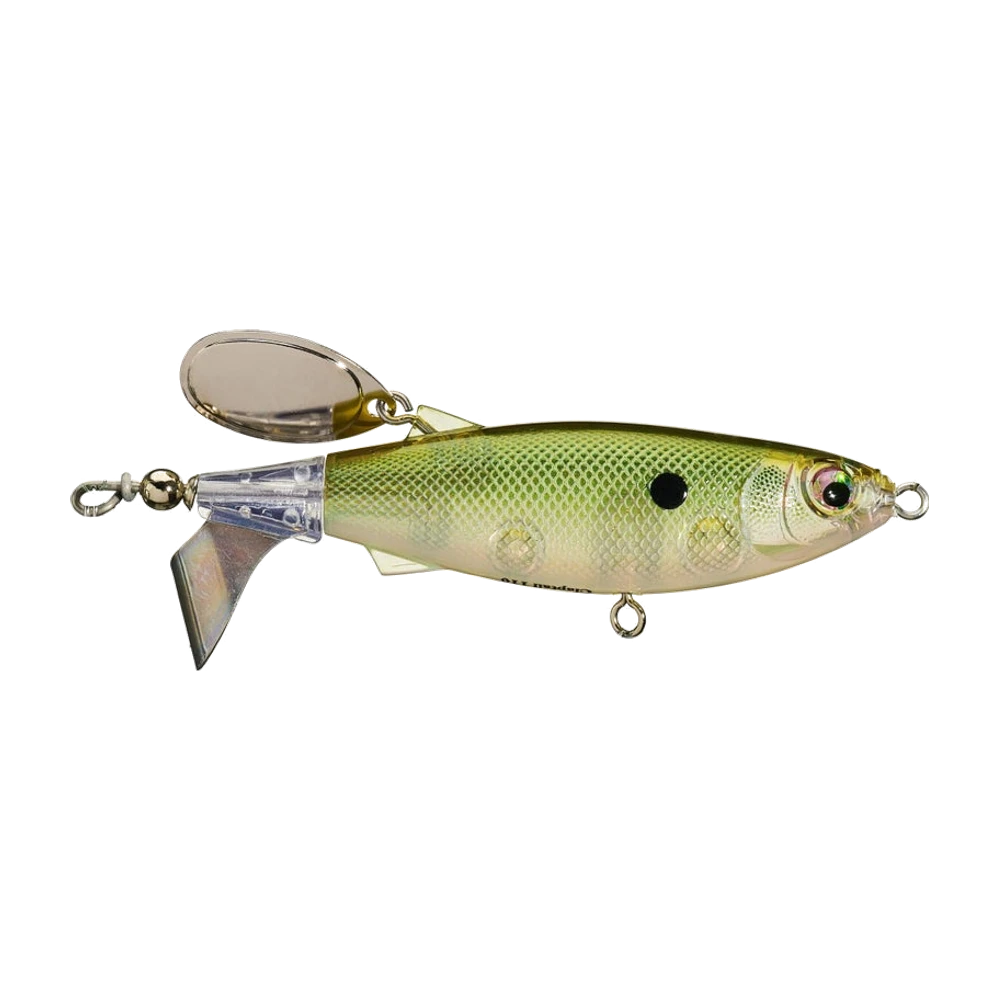
In practice, the 75 is a perch and small bass size, castable on a medium-light setup. The 90 is the all-round compromise. The 110, the one in the photo, already calls for a medium-heavy casting setup and targets adult fish — it is also the only size that makes sense if you are after pike.
Working it: the clack has to be earned
The temptation with a noisy bait is to work it like a popper. That is not it. The Claptail works on a straight retrieve, and the rotation speed of the prop governs everything.
Too slow, and the two metal parts never meet: you get a discreet wake and nothing else. Too fast, and the prop spins continuously, the clack drowns in a uniform noise and the bait eventually skates off to one side. The right speed is found by ear, and it usually sits just above the point where the prop starts turning: you should hear a rhythm, not a hum.
The pattern that works best is simple. A steady retrieve over five to ten metres, then a hard stop of one or two seconds, then back on. The stop does two things: it lets the prop finish its rotation on momentum, which produces one or two very audible isolated clacks, and it gives a following fish time to commit. Most strikes land within a second of the restart.
The classic mistake
Setting the hook on the sound. On a topwater, the strike is visual and audible before it is felt: you see the boil, you hear the take, and your reflex is to lift the rod. Nine times out of ten the fish does not have the bait in its mouth yet, and you pull it away. Wait until you feel the weight in the rod, then sweep sideways, with no vertical jerk. It is the hardest discipline in surface fishing, and it is what separates a three-fish day from a day with ten strikes and one fish landed.
One habit that changes your hook-up rate on this bait: listen to it instead of watching it. When you stare at the lure, you anticipate the strike. If you focus on the rhythm of the clack, you hear the exact moment it stops — that is the reliable signal, and it comes a fraction of a second before you feel anything.
The hardware, and what the photo shows
Rapala lists two VMC black-nickel trebles, described as hybrid and 1x strong, plus a swivelling front hook hanger meant to stop a fish from gaining leverage to throw the hook.
The product photo, for its part, shows the bait without its hooks: all you can see is the nose eye, a screwed-in belly loop, and, at the very end of the clear tail section, an assembly with a bead and a swivel. In other words, the swivel visible in the image sits at the rear — that is an observation from a product photo, not a specification, and it does not necessarily contradict what Rapala states, since the brand does not say how each hanger is oriented in the packaging. What matters is the principle: at least one of the two hangers is free to rotate, which is a genuine advantage on a topwater where the fish thrashes with its head out of the water.
On the line side, a snap or a loop knot leaves the nose free and does not smother the prop. A knot cinched directly on the split ring will not destroy the action the way it would on a lipped crankbait, but it stiffens the whole thing and delays the prop starting up at the beginning of the retrieve. For pike, a thick fluorocarbon leader is not enough: surface strikes are often head-on, so wire or titanium is required.
Not sure what to tie on?
Photograph your spot: CarnaFish reads the scene, cross-checks the conditions and gives you the zone, the lure and the retrieve. Free on iOS and Android.
Colours by light
On a topwater, the fish mostly sees a silhouette against the sky. The colour of the back therefore matters less than the contrast of the belly and the amount of flash thrown off by the metal parts.
- Clear water and full sun: a natural baitfish or perch finish, green back and pearly chartreuse flanks as in the photo. The chrome parts are already doing all the flash work.
- Grey skies or lightly stained water: a pearl white, which keeps clean contrast under diffuse light without adding useless glare.
- Dawn, dusk, night fishing: a solid dark tone, black or brown. The silhouette stands out better against the sky, and the bait then works mainly through sound.
Against the other topwaters
The Claptail does not fill the same slot as a River2Sea Whopper Plopper 130: the Plopper makes a big, rhythmic, continuous wake, designed to be located from a long way off in choppy water. The Claptail plays finer, with a metallic signal that carries differently over a smooth surface.
Against a Heddon Torpedo, the gap is subtler: both are prop baits, but the Torpedo has only one prop and makes an even noise, while the Claptail's clack comes from two parts touching. On fish that have already seen classic prop baits, that difference is worth the change.
And against a walking bait such as the Rapala Skitter Walk, the logic is reversed: walking the dog needs constant rod work and an active fish, while the Claptail only asks for a steady retrieve and does better when you have to cover surface without knowing where the fish is.
Knowing whether the surface is the right layer to attack on a given morning is worth more than knowing ten topwaters: CarnaFish reads a photo of the spot and suggests the zone and the water layer to work first. To lay down the basics of choosing a lure to match the spot, our guide to getting started on bass is still the best way in.
Key points
- The noise does not come from the prop alone but from the collision between the prop and the trailing blade: an intermittent clack, not a continuous hum.
- Three sizes, all classed Topwater. The inch and ounce figures are conversions of the 75, 90 and 110 mm formats, so treat the gram equivalents as orders of magnitude.
- Steady straight retrieve with a one to two second stop every few metres. Most strikes come on the restart.
- Never set the hook on the sound: wait until you feel the fish, then sweep sideways.
FAQ
Which Claptail size should you start with?
The 90 is the best compromise: bulky enough to pull up an adult bass, light enough to stay castable on an all-round setup. Take the 75 if perch are your main target, and the 110 for big fish or when pike are around.
How fast should you retrieve it?
Just above the minimum speed that gets the prop turning. You should hear a distinct, rhythmic clack; if the noise turns continuous you are going too fast, and if you hear nothing you are going too slow.
Does the Claptail float at rest?
Rapala classes all three sizes as Topwater, so yes, it stays up when you stop reeling. That is what lets you work in pauses without the bait dropping out of the surface layer.
Can you fish it for pike?
Yes, mainly in the 110, but only with a titanium or soft wire leader. Surface strikes are often head-on and the fish frequently takes the head of the bait, which puts the line exactly where you do not want it.
What hooks come fitted?
Rapala lists two VMC black-nickel 1x strong trebles, described as hybrid. The product photo, however, shows the bait bare, without its trebles: only the hangers are visible.
Why do I miss so many surface strikes?
Because you are setting too early, almost every time. The visible boil is the moment the fish hits the bait, not the moment it has it in its mouth. Wait for solid resistance in the rod before setting, and sweep to the side rather than upwards.
The full bass lure guideSeason-by-season strategy: which family of lure, when, and why.Go from theory to fish
CarnaFish reads your spot from a photo and gives you the game plan: zone, lure, retrieve. Free on iOS and Android.