Storm Arashi Cover Pop: the popper built to travel as little as possible
Not sure this lure fits YOUR spot today? CarnaFish tells you in 10 seconds, from a photo.
A dock, three pilings, a patch of shade barely two square metres across. You know a fish is sitting under it, and you also know a standard popper will cross that patch in two pops, long before the fish makes up its mind. The whole case for the Cover Pop sits in that scene: Storm designed it to move forward as little as possible with each rod tap.
What the sheet gives, and what it does not
The manufacturer's table carries only two useful columns, length and weight, preceded by the model name. It reads 3-1/8 inches and 1/2 ounce, which converts to 7.9 cm for 14.2 g. Since the original figure is in inches, the metric value is a rounded conversion: do not look for a clean 8 cm, the imperial fraction is the reference.
There is, on the other hand, no buoyancy column in that table. The description does unambiguously present a lure that works at the water's surface and imitates prey struggling right there. That is what I will state and nothing more: no density, no numeric class is published for this model.
Fourteen grams for eight centimetres is a high ratio for a popper this size, and there is a reason: Storm advertises an extra tail weight meant to extend casting distance. That weight has a side effect the maker also claims, a quieter entry into the water - the lure lands tail first rather than flat.
Travelling less, and why that is a real advantage
The core claim is easy to state and hard to engineer: Storm says the Cover Pop moves very little forward with each twitch, maximising the time it spends in the strike zone. That is a manufacturer claim, but it matches a visible shape decision - a short, stocky body with a deeply cupped mouth.
The practical value shows up as soon as you fish point targets rather than linear banks. On a laydown, a dock piling or an isolated boulder, you can string six or seven pops together in the same place without leaving the zone. A popper that travels decisively, like a Rebel Pop-R, forces you to recast three times to get the same presentation time.
The splashdown deserves as much attention as the retrieve. On a tight target, the lure's first contact with the surface sets up everything: a bait landing flat half a metre from a piling spooks the fish instead of alerting it. The tail weight Storm advertises plays a direct part here, since it makes the lure arrive tail first. Your job is to finish it off by thumbing the spool at the end of the cast so the lure settles rather than slaps.
The pause is worth more than the pop. After two or three taps, count three full seconds without touching the rod, just letting the rings spread. That silence is almost always when the fish comes up, not the noise.
Working it, pop by pop
Rod tip down, line slightly slack, short sharp wrist taps. The movement comes from the wrist, never the arm: pull with the forearm and the lure covers a metre per tap, which costs you exactly what you bought it for.
Three cadences worth knowing
Short bursts - two pops, three seconds of pause - suit calm water and wary fish. The string - six to eight pops close together with no pause - draws fish from a distance on water rippled by wind, when sound carries poorly. Finally, the single pop followed by a very long pause is the cold-water or early-season cadence, when fish will come up but slowly.
The classic mistake
Striking at the noise. On a popper the fish often misses its first swipe, and lifting the rod as the water erupts pulls the lure out of a mouth that has not closed on it. Wait until you feel the weight, then set sideways. The discipline is the same with a Rapala Skitter Pop or a Megabass Pop-X.
Not sure what to tie on?
Photograph your spot: CarnaFish reads the scene, cross-checks the conditions and gives you the zone, the lure and the retrieve. Free on iOS and Android.
Hooks and rigging
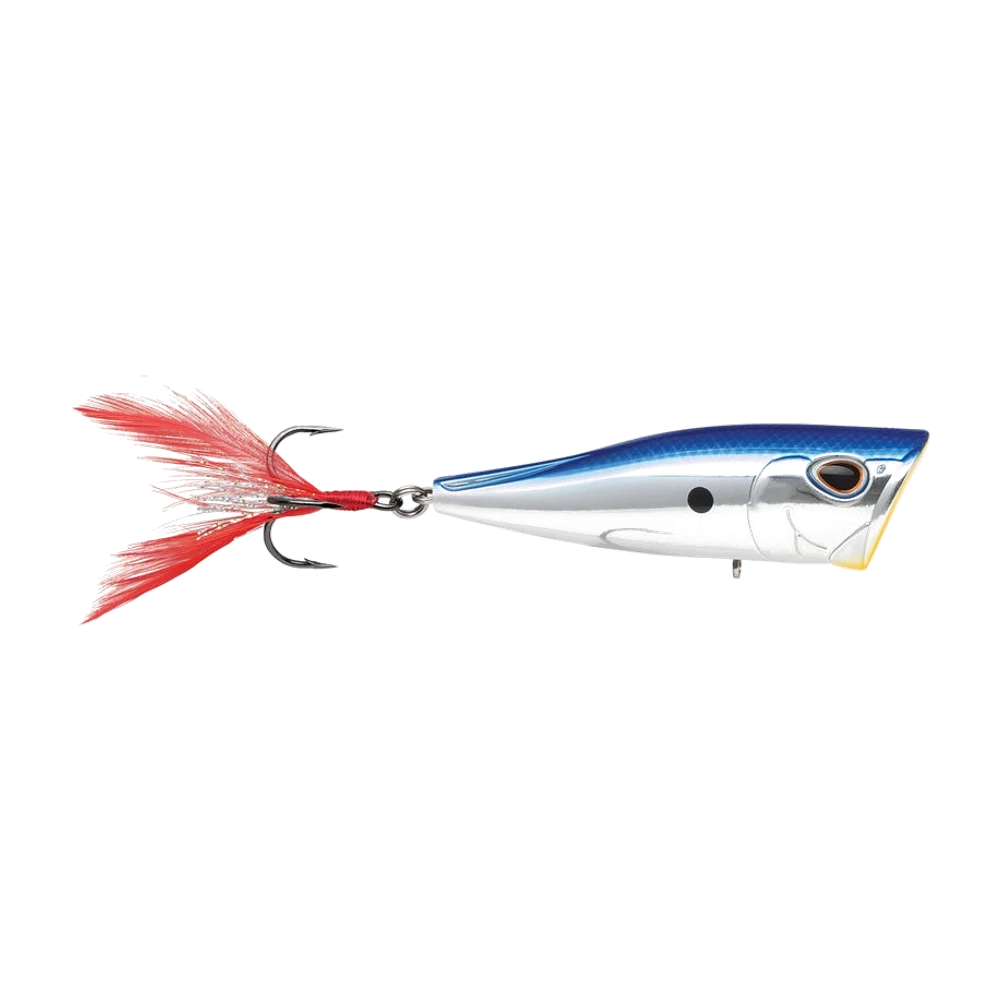
Storm specifies a rotated hook hanger and VMC black-nickel trebles. The rotated hanger presents the treble on an axis that reduces leverage during the fight and limits the hook pulling free when a fish jumps, which happens constantly in surface fishing.
In the product photo a single treble is fitted: the rear one, dressed with red and silver feathers bound with red thread. The belly hook hanger is visible but bare. That is an observation from a product photo, not a specification - the description itself refers to trebles in the plural.
For line, use thin braid to transmit the wrist tap without stretch, extended by about a metre of fluorocarbon leader. Above all, leave the lure's nose free: a knot cinched straight onto the split ring restricts how the mouth tips and smothers the pop. A loop knot or a small snap changes the sound completely.
Colour by water and light
- Clear water, bright sky: the chrome with a blue back from the photo, which throws short flashes with every splash without looking like a sheet of metal at rest.
- Lightly stained water: a pale wounded-baitfish tone, white belly and pink flanks, easier to read from below when visibility drops.
- Low light, dawn and dusk: solid black, which gives the cleanest silhouette seen from underneath against a pale sky.
In Europe this eight-centimetre format also steps outside the use Storm planned for it: it matches the prey size sea bass look for over rocky plateaus, and a chrome finish is a classic there. That is a local adaptation, not a stated use - the manufacturer talks exclusively about freshwater fishing around cover.
A cover popper is only worth carrying if you know where the structure holding fish actually is. That is exactly what CarnaFish makes easier: a photo of the spot, and the app suggests the zone, the depth and the type of presentation consistent with the day's conditions. To learn to spot those targets by eye, our guide to reading a fishing spot covers the clues to look for before you even tie on a lure.
Key takeaways
- 7.9 cm for 14.2 g, published as 3-1/8 in and 1/2 oz: the metric value is a rounded conversion.
- No buoyancy class is published; the description states surface work and nothing further.
- The lure is built to move forward very little per pop, which suits point targets rather than long banks.
- A tail weight is claimed for casting distance, and a rotated hook hanger to limit pulled hooks.
FAQ
What size and weight is the Cover Pop?
The manufacturer's table publishes a single version, 3-1/8 inches for 1/2 ounce, that is 7.9 cm and 14.2 g. The metric figure is a rounded conversion of the original imperial value.
Does this popper float?
No buoyancy column appears in the table and no density is published. The description states the lure works at the water's surface imitating struggling prey, and that is the only claim to lean on.
How does it differ from a standard popper?
Storm designs it to move very little forward with each twitch, which extends the time it spends in front of a piece of cover. A popper that travels further crosses the zone in two taps and forces a recast.
How do you work it around tight cover?
Short sharp wrist taps with the rod tip low, stringing two or three pops together then marking a full three-second pause. The bite most often comes during that pause.
What hooks are specified?
The description mentions VMC black-nickel trebles and a rotated hook hanger, without publishing a size. In the product photo, only the feathered rear treble is fitted.
Can you use it in saltwater for sea bass?
The size and the chrome finish lend themselves to it over rocky plateaus, but that is an angler's adaptation: Storm describes a freshwater use around cover exclusively. Rinse the hardware carefully after every saltwater session.
The full bass lure guideSeason-by-season strategy: which family of lure, when, and why.Go from theory to fish
CarnaFish reads your spot from a photo and gives you the game plan: zone, lure, retrieve. Free on iOS and Android.