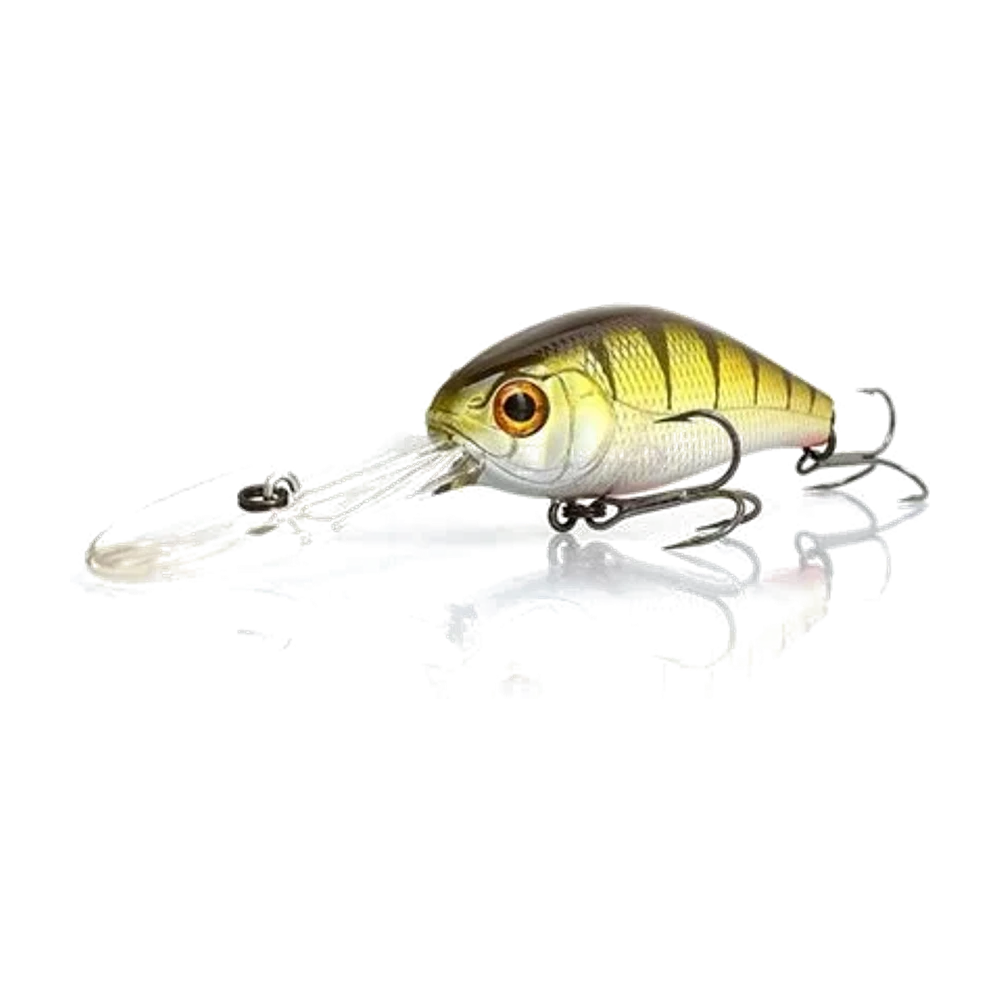
ZipBaits B-Switcher: a crankbait, not a minnow from the same brand
Before tying this one on, it helps to know if the spot actually calls for it. CarnaFish reads the scene from a photo.
Plenty of anglers discover ZipBaits through the minnows: the Rigge, the Orbit, slim lures you twitch and leave suspended. The reflex is then to buy a B-Switcher expecting more of the same. That is a family error. The B-Switcher is a crankbait, meaning a thick-bodied lure with a wide lip, retrieved continuously, that works by hitting things. You do not twitch it, and you do not give it ten-second pauses.
What makes this model special lies elsewhere, and it is very practical: the range is organised into numbered series, each matching a running depth. Instead of hunting for your water layer by juggling speed and rod angle, you change number and the lure handles the rest, at normal speed.
That is methodical coverage, not finesse.
The series: one depth per number
On a classic crankbait, depth depends on three tangled variables — lip length, speed, line diameter. With a series system, you fix one of them and everything else gets simpler.
| Series | Indicative depth | Use |
|---|---|---|
| 1.0 | around 1 m | margins, flats, tall weed |
| 2.0 | 1.5 to 2 m | the most productive band in a lake |
| 3.0 | 2.5 to 3 m | drop-offs, flats, dam walls |
The practical value shows up the moment a fish is located. You get bites at two metres, you switch to the 2.0 series and you spend the day in exactly that band, without counting seconds or fine-tuning your speed to the millimetre.
Two other points set this lure apart:
- Buoyancy depends on the version: floating, to rise on the stop and free itself from an obstacle; suspending, to stay in the water layer after contact. The suspending version is clearly more effective in cold water.
- A choice between silent and rattling versions. In clear water and on educated fish, the silent version often catches more. In stained or churned water, the rattles add a useful signal.
The retrieve: make the lure hit things
A crankbait that touches nothing catches almost nothing. The whole exercise is picking a series that dives slightly deeper than the bottom you are targeting, to guarantee contact.
- Choose your series according to the real depth, always taking the step that goes a little too deep.
- Cast beyond the zone and retrieve at a constant, moderate speed to bring the lure to its running depth.
- Look for contact. Rocks, a stump, the edge of a weed bed: the lure should scrape or knock. You feel the vibration break.
- Stop for one second straight after the knock. In the floating version the lure rises slightly and frees itself. In the suspending version it stays put, exactly where it hit.
- Start again at the same tempo without speeding up.
On the water: do not try to avoid obstacles, try to hit them. A crankbait that knocks a stump and kicks off sideways draws far more strikes than a crankbait that passes cleanly over the top. So always pick the series immediately deeper than your bottom, and accept that it will scrape — that is the whole principle of the lure.
Line, rod and rigging details
Line diameter has a direct effect on the depth reached. 0.20 mm fluorocarbon lets the lure go as deep as it can; 0.25 mm costs it twenty to thirty centimetres. That is a handy adjustment when you want to fish between two series.
The rod matters too. A blank that is too stiff pulls the lure free on the hookset and rips the trebles out of a perch's mouth. A rod with a semi-parabolic action, in 7 to 21 g, absorbs head shakes and noticeably improves conversion on vibration bites.
A clip is acceptable here, unlike on a small minnow: the lure's mass and the lip area make the action fairly insensitive to a few extra tenths of a gram. On a spot where you alternate series, it saves a lot of time.
Finally, check the alignment of the line tie after every fish. A crankbait whose eye is bent off to one side swims crabwise and loses all its effectiveness — a squeeze of the pliers straightens it in five seconds.
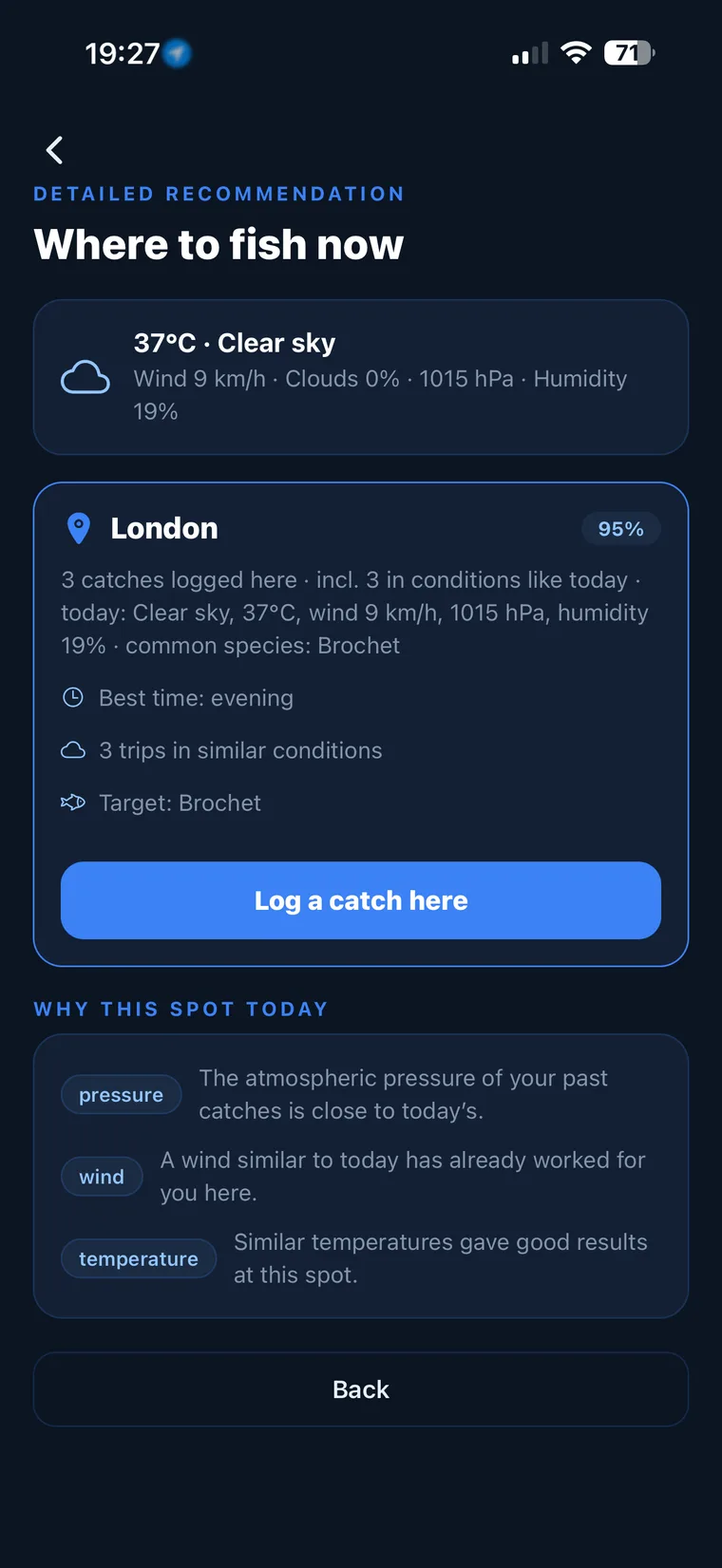
Not sure what to tie on?
Photograph your spot: CarnaFish reads the scene, cross-checks the conditions and gives you the zone, the lure and the retrieve. Free on iOS and Android.
Its windows, and the ones where it disappoints
The B-Switcher is an efficient searching lure on readable water.
- Lake and gravel-pit margins in spring and autumn, when perch and bass patrol between one and three metres.
- Dam walls and shallow rip-rap, where the deflection off the stones triggers.
- Weed beds late in the season, on the 1.0 series brought back just over the vegetation.
- Windy days: its compact mass casts a long way and the vibration stays noticeable in chop.
On the other hand it is out of place beyond three metres: it is not a deep crank, and to reach a fish at five metres you need a very long-lipped model. It is also wrong for inactive fish in cold water that no longer react to a lure retrieved continuously — there, a suspending jerkbait with long pauses takes the advantage back. Finally, in dense brush and drowned timber, its two trebles make it an expensive lure to use.
B-Switcher, Rigge 70 or Shad Rap
This is the most useful comparison for avoiding confusion. The ZipBaits Rigge 70 is a minnow: slim body, short lip, tight action, built to be twitched with pauses and to play on finesse in clear water. It has neither the same depth, nor the same way of being worked, nor the same role. If you want to work a precise spot holding wary fish, that is what to reach for — not the B-Switcher.
The Rapala Shad Rap is the real competitor: a flat-bodied crankbait with a tighter, quieter action, with a reputation on difficult fish. The B-Switcher offers a wider roll and a stronger vibration, so a louder signal, to favour when the water colours up or the fish are active.
The Berkley Frittside illustrates yet another route, the flat-sided crankbait for cold water, with a finer action. Our guide to lure fishing for perch covers which water band to work first. And if you are unsure which series to tie on when you reach a drop-off, CarnaFish analyses a photo of the spot and answers.
Key takeaways
- It is a crankbait: continuous retrieve, no twitching and no long pauses.
- Depth is chosen by series number, not by speed or rod angle.
- Always take the series that dives a little deeper than the bottom: contact makes the bite.
- Silent version in clear water, rattling version in stained water; suspending in the cold.
- Off-topic beyond three metres, on apathetic fish and in dense drowned timber.
FAQ
Which B-Switcher series should you buy first?
The 2.0 series, which covers the 1.5 to 2 m band where most lake perch and bass hold. Then add the 1.0 for margins and weed beds, and the 3.0 for drop-offs and dam walls.
What is the difference with a Rigge or an Orbit?
Those are minnows: slim body, short lip, tight action, worked in jerks with pauses. The B-Switcher is a thick-bodied crankbait retrieved continuously that works in contact with the bottom. The two families do not cover the same situations.
Silent version or rattling version?
Silent in clear water, on heavily fished venues or when the fish have already seen plenty of lures go by. Rattling as soon as the water colours up, there is chop, or you want to call from a distance.
Do you really have to bump the lure along the bottom?
Yes, that is the principle of a crankbait. The knock breaks the action for a fraction of a second and triggers strikes far more effectively than a clean pass. Choose a series that runs slightly deeper than the real bottom.
What line should you use?
Fluorocarbon of 0.20 to 0.25 mm. The 0.20 mm lets the lure reach its maximum depth, the 0.25 mm costs it twenty to thirty centimetres, which lets you fine-tune without changing series.
Can you use it in winter?
Yes, in the suspending version, at reduced speed and working contacts followed by one to two second stops. On genuinely inactive fish, though, a suspending jerkbait with long pauses or a slow soft plastic will still do better.
The full bass lure guideSeason-by-season strategy: which family of lure, when, and why.Go from theory to fish
CarnaFish reads your spot from a photo and gives you the game plan: zone, lure, retrieve. Free on iOS and Android.