Googan Revolver: the prop topwater built to convert more strikes
This lure shines under specific conditions. CarnaFish tells you in 10 seconds if today is one of them.
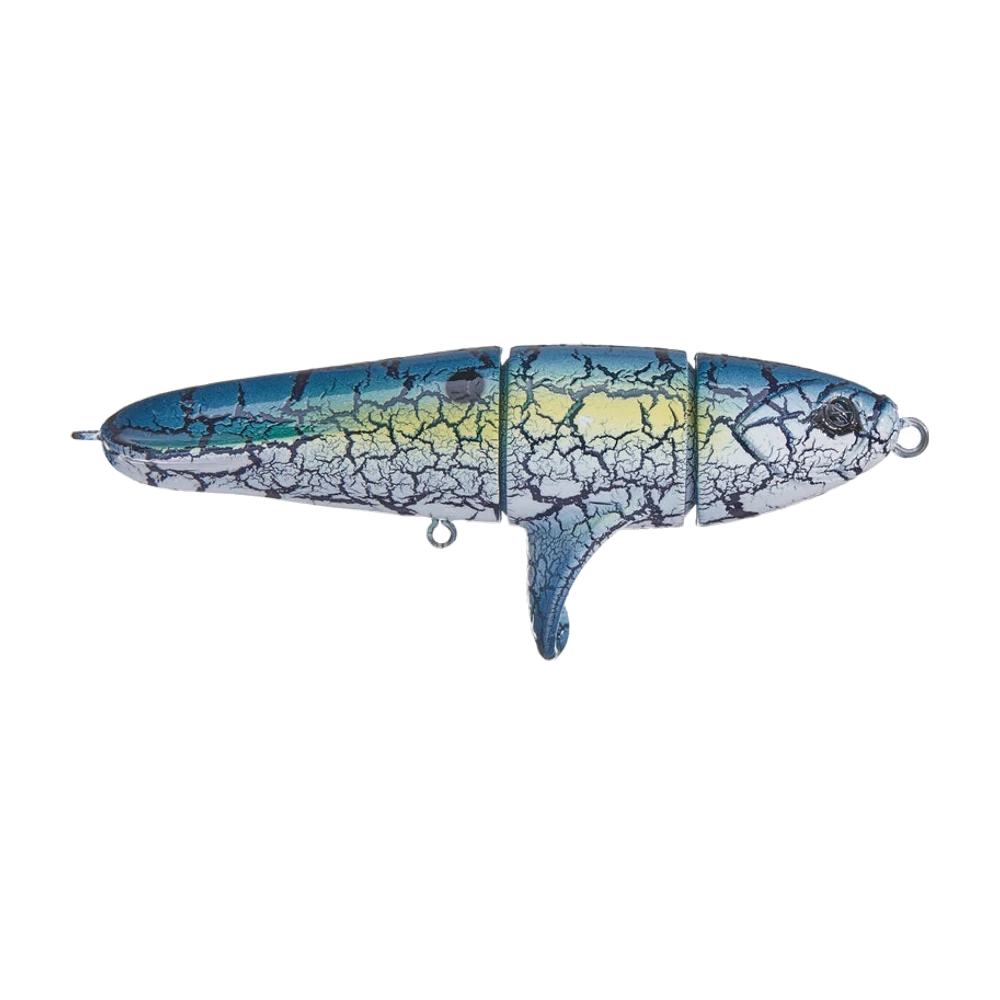
A standard plopper is a prop at the end of the tail and an outboard-motor noise that pulls fish in from a long way off. The problem is familiar to anyone who has fished one for a season: the fish strikes where the noise is, which is behind the lure, where there is usually nothing to bite. You hear the explosion, you set into thin air, and you start again. The Googan Revolver attacks that flaw head-on by moving the fin to the middle of the body.
Why fin position changes the outcome
Googan describes a rotating fin mounted at the centre of the bait, and gives a purely mechanical reason for it: putting the noise source in the middle makes the hooks the fish's target rather than the tail. The argument holds up. A predator striking a topwater aims at what moves and what clatters — move the source of the noise and you move the point of impact.
The maker expects three consequences from this: a better hook-up ratio, far fewer short strikes, and fish drawn straight to the business end of the bait. On the water it is the second one you notice fastest. Missed strikes are part of daily life in prop-bait fishing, and anything that reduces them is measured in fish actually landed by the end of the day.
There is a flip side, and it is fair to say so: a centre fin churns its water closer to the centre of gravity, so with less leverage than a prop hung off the tail. Do not expect the racket of a big 13 cm plopper. The signal is there and steady, but more contained.
The flattened tail does the other half of the job
The second technical claim is a flattened tail meant to stop the lure rolling over at any speed. That detail matters enormously on a prop bait: as soon as you speed up, the fin's torque tends to spin the body around its axis, and a rolling lure stops producing its noise and wanders off line.
The flat tail acts as a keel. It keeps the body level and converts that torque into lateral movement: instead of rolling, the Revolver jitters and shimmies as it travels. The practical consequence is that you can speed up when fish are active, or along a long bank you want to cover fast, without the lure quitting on you. That is rarely true of an entry-level plopper.
Two sizes, one weight: read the table carefully
The manufacturer's table lists two versions, and it rewards a close reading because it holds a surprise:
- Mini Revolver: 3.5 in, or 8.9 cm, at 1/2 oz, roughly 14.2 g. Class: topwater.
- Revolver: 4.25 in, or 10.8 cm, at 1/2 oz, roughly 14.2 g as well. Class: topwater.
So both sizes are quoted at the same weight despite 2 cm of difference. That is not necessarily an error: a longer hollow body can perfectly well stay at the same weight if the internal volume compensates. But it carries a practical implication nobody will explain to you in a shop: the Mini is the denser of the two, so it casts better into a headwind and lands with less finesse. If you are on wary fish in clear water, the bigger size will touch down more gently for the same weight.
As for tackle, 14.2 g in both cases is a straightforward medium-heavy casting outfit. No swimbait rod required.
How to fish it
Start with a straight retrieve, nothing else
A prop bait is first and foremost a steady-retrieve lure. Cast, lift the rod to get the fin turning, then find the slowest speed at which it spins without stuttering. That is the speed where the lure works best: slow enough to give a fish time to come up, fast enough that the signal never stops.
The variations that trigger
The adjustment that makes a difference comes down to two moves. First, a short burst of two or three handle turns just as you pass a laydown, a pad edge or the corner of a dock. The change of rhythm makes a following fish commit. Second, a dead stop of one second. The lure halts, the fin goes quiet, and that abrupt silence is what triggers a hesitating fish.
Keep the rod low and pointed at the lure through the whole retrieve. Fish with the rod high and the line lifts the nose, the fin half leaves the water and the lure loses half its noise. That is the first thing to fix whenever "it isn't plopping".
The classic mistake
Setting on the sound. It is the universal topwater error and the Revolver does not escape it, even if its design limits the damage. You see the spray, you set, the lure flies back at you. Keep reeling at a steady speed until you feel the fish's weight in the rod, then set with a sweep. A prop bait has one advantage: if the fish missed, it often stays on the lure as long as the fin is still turning, so do not stop.
Not sure what to tie on?
Photograph your spot: CarnaFish reads the scene, cross-checks the conditions and gives you the zone, the lure and the retrieve. Free on iOS and Android.
Colour by water and light
- Lightly stained water: the blue and chartreuse crackle in the photo, which adds a visible contrast point without tipping into a garish colour.
- Clear water: a pearl-white shad pattern, consistent with the forage when visibility gives the predator time to inspect.
- Overcast skies, late in the day: matte black. On the surface the fish looks upward, and the backlit silhouette counts far more than the actual hue.
Where it belongs in a topwater box
The Revolver fills an in-between slot, between the pure plopper and the topwater stickbait. To cover a long bank fast with maximum noise, a River2Sea Whopper Plopper 130 is still louder and longer. To work one precise spot on the spot, a popper like the Googan Blooper Popper lets you animate without travelling. And when fish refuse anything noisy, a silent walking bait like the Heddon Super Spook or a Rapala Skitter Walk takes over. The Revolver sits in between: continuous noise while still covering ground.
A word on species: Googan designed and sells it for bass, and its table talks about nothing else. In Europe, the 10.8 cm size is also a sound choice for summer pike over weed flats and reed edges, provided you add a leader that copes with the teeth.
Picking a topwater is mostly about picking the right moment and the right bank. That is exactly what CarnaFish does: a photo of the spot, and the app suggests the zone to attack and the lure type that fits the day's conditions. To widen the subject on the pike side, our guide to choosing a pike lure complements this page well.
Key takeaways
- The fin sits at mid-body rather than off the tail: fish strike the hooked section and short strikes drop off.
- The flattened tail works as a keel and stops the body rolling, which allows fast retrieves without losing the noise.
- Two sizes quoted at the same 14.2 g: the 8.9 cm Mini is therefore the denser one and the easier to cast into wind.
- Rod low, steady retrieve, and set on felt weight, never on the sound you hear.
FAQ
Which Revolver size should I pick?
The 8.9 cm Mini Revolver for average fish, in sustained wind or around tight cover. The 10.8 cm Revolver when you want a bigger silhouette or you are fishing for bigger fish. Since the quoted weight is identical, the choice is about profile size, not casting distance.
How is it different from a standard plopper?
In where the fin sits. On a traditional plopper the prop is at the tail and fish strike behind the lure, often at nothing. On the Revolver the fin is at the centre of the body, so the noise source lines up with the hooked section, which mechanically cuts down short strikes.
Does the Revolver float at rest?
The maker explicitly lists it as topwater in its table, and it is built to stay up there: the fin only spins when the body is right at the surface. It is also described as weighted to land upright on every cast, which saves you reeling three metres just to get it the right way round.
Do I need a wire leader?
Not for bass: a short 25-30 lb fluorocarbon leader behind the braid is enough and stays discreet. In Europe, if you are fishing a pike spot, yes, a suitable leader is essential, and you have to accept the slight loss of surface action it imposes.
How fast should I retrieve it?
Start at the slowest speed where the fin spins without stuttering, and stay there. Short bursts are a one-off trigger as you pass cover, not a cruising speed. The flattened tail does let you speed up hard without the lure starting to roll.
What hooks should it carry?
The manufacturer's description does not specify the size or type of hooks supplied: check that on the packaging before you fish it. The usual topwater habit still applies — inspect the points after every fish, since surface hooks take a beating against bony jaws.
The full bass lure guideSeason-by-season strategy: which family of lure, when, and why.Go from theory to fish
CarnaFish reads your spot from a photo and gives you the game plan: zone, lure, retrieve. Free on iOS and Android.