Lake Fork Live Magic Shad: one soft swimbait, six rigs
Before tying this one on, it helps to know if the spot actually calls for it. CarnaFish reads the scene from a photo.
There are two families of soft plastics: the ones that force a single rig on you, and the ones that accept six. Lake Fork's Live Magic Shad belongs firmly to the second — the brand itself lists weightless, Texas, Carolina, drop shot, wacky and jighead. That's both its strength and the trap you fall into: a bait that goes everywhere often ends up rigged any old way.
Three lengths, and numbers you shouldn't confuse
The spec sheet runs to two lines, but it reads badly in a hurry. Lake Fork gives three lengths with, beside each one, the number of baits per pack:
- 3.5 in, 8.9 cm — 6 baits per pack.
- 4.5 in, 11.4 cm — 4 baits per pack.
- 5.5 in, 14 cm — 3 baits per pack.
Those 6, 4 and 3 are not weights, not gram ratings, not model numbers: it's pack contents, which logically drops as the size goes up. And Lake Fork publishes no weight at all for this bait. If you need the mass to match a rod rating or a jighead, you'll have to weigh one yourself: quoting a figure here would be invention.
In practice the 8.9 cm / 3.5 in is a do-everything size that interests bass and perch alike in summer, the 11.4 cm / 4.5 in is the broadest compromise, and the 14 cm / 5.5 in becomes a selective bait when you're after better fish and accept fewer bites.
A very soft plastic, and what that implies
Lake Fork leans on two formulation points: the bait is impregnated with garlic and moulded in super soft plastic, which the brand says makes fish hold on longer. That's something you can verify on the water: one extra second before the bait is spat out is exactly the time you need to set the hook cleanly on a bass that inhaled it at distance.
The trade-off is mechanical. A very soft plastic tears faster, especially where the hook anchors. Two habits fix it: slide a short piece of heat-shrink or a bait keeper onto the shank to spread the load, and shift the hook entry a millimetre every time you re-rig instead of going back into the same hole. With a pack holding 3 or 4 baits depending on size, that detail changes what your day costs.
Store your Live Magic Shads flat, never bent into a box that's too short. Plastic this soft keeps whatever shape you impose during storage, and a slightly twisted body won't swim straight — the silliest failure you can inflict on this kind of bait.
What the photo shows, and what the sheet doesn't explain
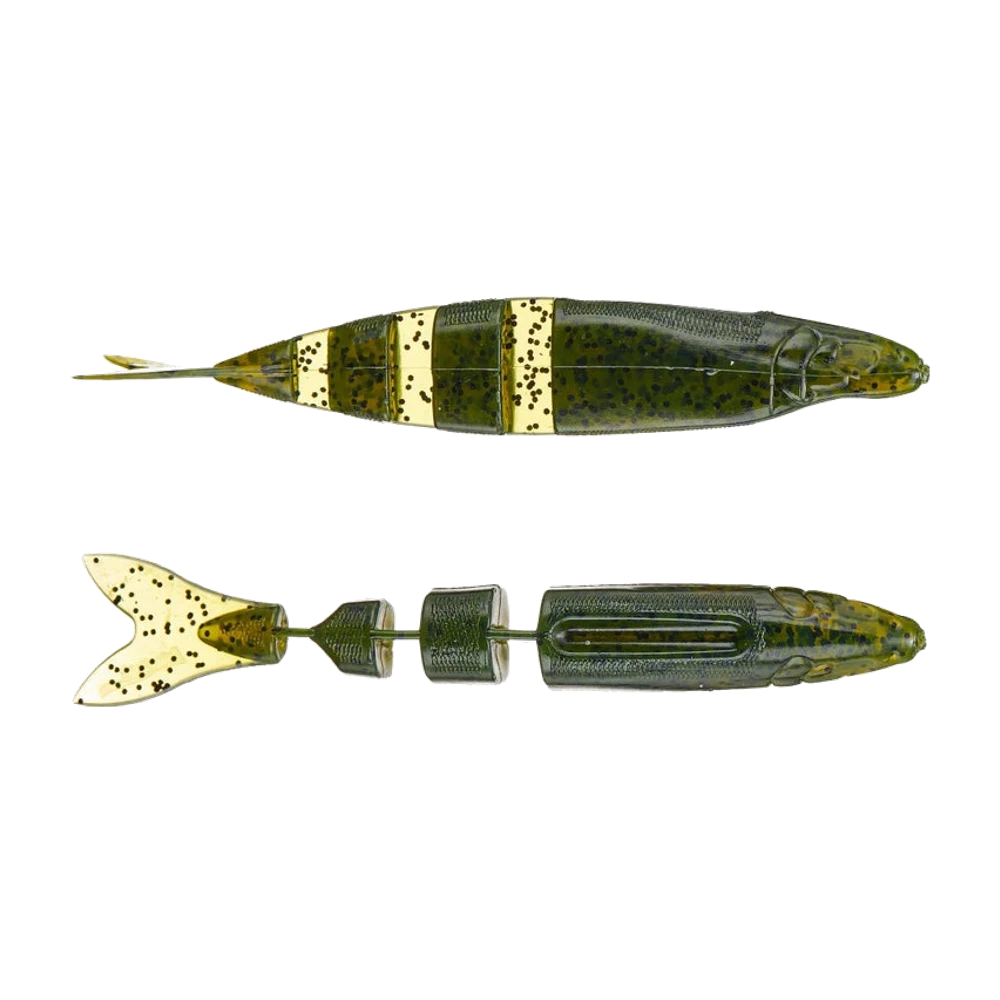
Lake Fork simply claims a "technically advanced" design that mimics the swimming motion of a fleeing baitfish on the retrieve. The sheet never says how. The photo does show a body split into segments linked by thin stems, a wide flat forked tail, and a long slot running the full belly of the front segment.
That slot is a hook groove: it's what lets you tuck the point back into the body for a genuinely weedless Texas rig without bulking up the profile. Bear in mind these are photo observations, not data published by Lake Fork — which describes neither the segmentation, nor the number of segments, nor the groove in its copy.
The six rigs, and which ones really earn their place
Jighead and Texas, the two main uses
On a jighead, the Live Magic Shad becomes a straightforward search bait: slow to medium straight retrieve, letting the body do the work with no rod action. That's the rig that best exploits the swim Lake Fork describes, since the claim is made for the retrieve. Texas rigged, point tucked into the belly slot, it slips through scattered wood and sparse grass. The Texas rig is still the best way in if you fish cluttered margins.
Drop shot and Carolina, to slow things down
The drop shot holds the bait at fish level while the weight holds bottom, and a body this soft quivers at the slightest rod-tip movement: it's the rig for days with no activity. The Carolina does something else — covering a big flat while the bait trails free behind the weight at a steady speed. Both are covered in our drop shot rig and Carolina rig pages.
Weightless and wacky, the two finishing rigs
Weightless, the bait glides down very slowly: deadly on a school of visible fish near the surface, unusable the moment there's wind or current. Wacky, hooked through the middle of the body, is a last-resort rig on a fish refusing everything. Honestly, these aren't the reasons you buy this bait — but they get you out of trouble.
The mistake that kills the swim
Oversizing the jighead. The urge is to get down fast, and too heavy a head flattens the swim of a soft body: the bait tracks in a straight line instead of undulating. Take the lightest weight that still keeps you in contact, and accept the wait on the drop. Same reasoning as on a Keitech Easy Shiner 4: the swim comes from the body, not the lead.
Not sure what to tie on?
Photograph your spot: CarnaFish reads the scene, cross-checks the conditions and gives you the zone, the lure and the retrieve. Free on iOS and Android.
Colour by water clarity
- Clear water: a flaked green pumpkin like the photographed sample, with the translucent gold flanks that let light through. It's the tone that forgives most on a fish with time to look.
- Stained water: a dark back with a chartreuse throat, giving an aiming point without turning the bait into a fluorescent flag.
- Low light or dark water: a solid dark colour, chosen for silhouette clarity seen from below rather than for the hue itself.
On a translucent body, remember the colour you see depends as much on transmitted light as on pigment: the same bait doesn't read the same at noon and at sunset.
Where it sits in a box
The Live Magic Shad is an unapologetic generalist, not a specialist's bait. It doesn't replace a big slow search worm like the Lake Fork Worm, and it won't do the job of a paddle tail thumping hard in dirty water. Its place is the box where you want one soft plastic able to move from rig to rig with nothing changed but the weight.
Choosing the right rig means first knowing where the fish are, and that's exactly what CarnaFish makes easier: a photo of the spot, and the app suggests a zone, a depth and a presentation matched to the day's conditions. To get the most from the 8.9 cm / 3.5 in size on perch water, our guide to perch fishing with lures covers the retrieves that work.
Key takeaways
- Three lengths — 8.9, 11.4 and 14 cm / 3.5, 4.5 and 5.5 in — and the 6, 4 and 3 beside them are baits per pack, not weights.
- Lake Fork publishes no mass for this bait: there's no reliable gram figure to give you without weighing one.
- Six rigs claimed by the brand, but jighead and Texas are the ones that best exploit the swim described for the retrieve.
- Super soft, garlic-impregnated plastic: more time before the spit-out, but a shorter service life than a standard soft bait.
FAQ
Which Live Magic Shad size should I choose?
The 8.9 cm / 3.5 in covers the most situations and interests perch too. The 11.4 cm / 4.5 in is the most versatile compromise for bass. The 14 cm / 5.5 in sorts for better fish but clearly cuts bite numbers: only bring it out when you know there's size in front of you.
What do the 6, 4 and 3 on the spec sheet mean?
They're the number of baits per pack for each length: 6 in 3.5 in, 4 in 4.5 in, 3 in 5.5 in. They are not weights or gram ratings — an easy confusion when the table is printed as a run-on line.
How much does this bait weigh?
Lake Fork doesn't publish it. The sheet gives only lengths and pack quantities. If you need the mass to pick a rod rating, weigh one: any other figure would be an unsourced guess.
Does the garlic plastic actually do anything?
Lake Fork claims the garlic, combined with a super soft plastic, makes fish hold on longer. What you mostly notice on the water is an extra beat before the bait is spat out — often enough for a clean set on a distant bite.
Can it be rigged weedless in vegetation?
Yes, Texas style, tucking the hook point into the belly slot moulded into the body. It clears scattered wood and sparse grass well. For a dense mat, a hollow-body bait remains the better tool.
Is it good for anything other than bass?
The 8.9 cm / 3.5 in size regularly takes perch along margins in summer, on a slow retrieve with a few pauses. Lake Fork is a bass-focused brand and its copy talks about nothing else: for pike, plan a suitable leader and don't expect long life from a plastic this soft.
The full bass lure guideSeason-by-season strategy: which family of lure, when, and why.Go from theory to fish
CarnaFish reads your spot from a photo and gives you the game plan: zone, lure, retrieve. Free on iOS and Android.